

Dental continuing education (CE) and continuing professional development (CPD) are essential components of modern dental practice worldwide. Whether you are a dentist, dental hygienist, or another dental care professional, it is likely that your regulatory body expects you to engage in structured learning throughout your career.
This guide provides a practical, global overview of dental CE/CPD. It defines what CE/CPD is, explains why it matters, and outlines typical requirements in the United States, Canada, the United Kingdom, continental Europe, and other regions. While it does not replace local regulations, it offers a clear framework to help you understand your obligations and plan your learning.
1. What Is Dental Continuing Education (CE/CPD)?
Dental continuing education (CE) or continuing professional development (CPD) refers to organized, planned learning activities that occur after you qualify and register as a dental professional. These activities are designed to maintain and enhance your clinical skills, professional judgment, and ability to provide safe, effective care.
In North America, the term “continuing education” and phrases such as “CE hours” or “CE credits” are commonly used. In the United Kingdom, continental Europe, and many other regions, the terminology shifts to “continuing professional development” and references to “CPD hours” or “CPD points.” In practice, both terms describe the same underlying concept:
- Ongoing, structured learning throughout a professional career.
- Activities with clear educational objectives.
- Content that is relevant to your scope of practice and current or future role.
- Documentation and evidence that you completed the activity.
CE/CPD goes beyond casual reading or informal conversations with colleagues. Most regulators expect a combination of the following:
- Defined learning outcomes or objectives.
- A specific topic and curriculum.
- A credible provider or educator.
- Proof of participation, such as a certificate, quiz result, or reflective note.
2. Why Dental CE/CPD Matters
2.1 Keeping clinical skills current
Dentistry evolves rapidly. New materials, digital workflows, implant systems, preventive strategies, and clinical guidelines emerge every year. Without structured learning, it is easy for knowledge and skills to become outdated.
Research in dentistry and the wider healthcare field shows that well designed CPD can improve clinicians’ knowledge and skills and change clinical behaviour, especially when activities are interactive, case based, and closely linked to everyday practice rather than purely lecture based.[1-3] Over time, these improvements can lead to better decision making and, in some cases, better patient outcomes.
2.2 Patient safety and public trust
Regulators and professional organizations view CE/CPD as part of the profession’s duty to the public. Patients expect that their dentist or hygienist is up to date with current standards in areas such as infection control, radiography, medical emergencies, and safeguarding. Ongoing education is one of the main ways to support this expectation and reduce the risk of outdated or unsafe care.[1,7,10]
In Europe, for example, CPD frameworks have been explicitly linked to quality assurance and public protection. Projects such as DentCPD and subsequent European analyses emphasize that CPD is not just a “nice to have,” but a critical element in ensuring safe, competent care across borders.[7,8,10]
2.3 Career development and mobility
From a clinician’s perspective, CE/CPD is also central to career development. It allows you to:
- Expand clinical services, such as implants, advanced endodontics, esthetics, airway and sleep dentistry, minimally invasive dentistry, or laser procedures.
- Explore specialist pathways or residency style programs.
- Develop skills in leadership, practice ownership, teaching, research, or mentoring.
- Strengthen your CV for roles in hospitals, corporate groups, or academic settings.
- Support cross border mobility, as regulators often review recent CPD as evidence of current competence.[10]
2.4 Regulatory and ethical obligations
In many countries, participation in CE/CPD is mandatory and explicitly stated in laws, regulations, or registration standards. Examples include:
- State dental practice acts and board rules in the United States.
- Provincial quality assurance regulations in Canada.[4,6]
- General Dental Council (GDC) CPD requirements in the United Kingdom.[5,12]
- CPD frameworks for dentists in most European Union and European Economic Area countries.[7,8,10]
- Emerging CPD systems in countries such as Ukraine and in parts of Asia and the Pacific region.[9]
Codes of ethics issued by national dental associations and regulators almost always include an explicit duty to maintain and update knowledge and skills. In short, CE/CPD is both a regulatory requirement and an ethical expectation.
3. Who Sets CE/CPD Requirements?
The specific number of required hours or points depends on where you are registered. There is no single global standard. Instead, CE/CPD requirements are set by:
- State or provincial regulators (for example, US state boards and Canadian colleges).
- National dental councils or authorities (for example, the GDC in the UK).
- Ministries of health or national health insurance bodies in some countries.
- In some cases, large professional associations working in partnership with government.
In Europe, the DentCPD project and later work have mapped how different systems operate country by country and highlighted the diversity of models, from points based systems to competency portfolios.[7,8,10] Similar mapping work has been done in other regions, such as Ukraine, where recent regulations formally define CPD points for dentists and maxillofacial surgeons.[9]
Because rules change over time, the most reliable way to understand your obligations is to check the website of your own regulator. The examples in this article are intended to illustrate common patterns, not to replace local guidance.
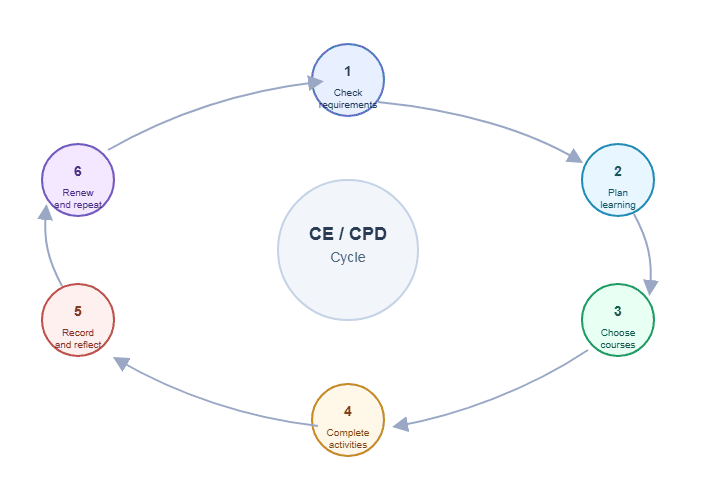
4. CE/CPD Requirements for Dentists: Key Regions
4.1 United States
In the United States, CE requirements for dentists are set by state dental boards or similar licensing authorities. Common features include:
- A fixed license renewal cycle, typically 1, 2, or 3 years.
- A minimum number of CE hours per cycle, often in the range of 20 to 60 hours.
- Rules about how many hours must be clinical rather than practice management.
- Limits on self study or reading only activities.
- Mandated topics such as infection control, ethics or jurisprudence, opioid prescribing, health equity, or suicide prevention.
For example, some states require around 60 hours of CE over a three year cycle, with specific requirements for infection control, medical emergencies, and other core topics. Others have lower overall hour requirements but stricter rules on subject areas. The details differ, but the principle is the same: over each renewal cycle, you must accumulate a specified number of hours and complete certain required subjects.
4.2 Canada
In Canada, dental CE is usually embedded in a quality assurance or competency program overseen by provincial dental colleges. These programs often combine:
- Minimum CE points or credits over a multi year cycle.
- Category systems that prioritize higher quality or more interactive learning.
- Self assessment tools and practice enhancement components.
In Ontario, for example, the Royal College of Dental Surgeons of Ontario (RCDSO) requires dentists with a general or specialty certificate of registration to obtain at least 90 CE points in each three year cycle as part of its Quality Assurance Program.[4,6,11] Similar three year, 90 credit frameworks exist in other provinces such as British Columbia, although the details of categories and acceptable activities vary slightly.[11]
4.3 United Kingdom
In the UK, all dental professionals are registered with the General Dental Council (GDC). The GDC runs an “enhanced CPD” scheme that applies to dentists and all dental care professionals.[5,12] Key features include:
- A five year CPD cycle for most registrants.
- Minimum numbers of verifiable CPD hours over that five year period.
- Requirements to have a personal development plan and to make annual CPD statements.
- Expectations around planning, doing, reflecting on, and recording CPD.
Guidance summarizing GDC expectations notes that dentists must complete at least 100 hours of verifiable CPD over a five year cycle. Dental therapists, hygienists, orthodontic therapists, and clinical dental technicians must complete 75 hours, while dental nurses and dental technicians must complete 50 hours.[5,12] Registrants also need to complete at least 10 hours of verifiable CPD across any two consecutive years.[5,12]
The GDC recommends that every dental professional carries out verifiable CPD in core topics such as:
- Medical emergencies.
- Disinfection and decontamination.
- Radiography and radiation protection (for those who undertake radiography).
Recommended minimums in these topics include regular training in medical emergencies and periodic updates in radiography and decontamination over each five year cycle.[5,8]
4.4 Continental Europe
Across continental Europe, CPD frameworks for dentists vary by country, but several common patterns have been identified in the DentCPD project and follow up surveys.[7,8,10] Many systems share the following characteristics:
- Mandatory CPD with minimum hours or points over multi year cycles.
- Points or credits linked to accredited courses, symposia, and other learning activities.
- Core topics related to patient safety, such as medical emergencies, infection control, and radiography, which are recommended or required.
Some countries use sanctions for non compliance, such as financial penalties, reduced reimbursement, or other regulatory consequences. Others focus more on supportive quality improvement but still expect documentation of CPD.[7,8,10]
4.5 Other regions
In other parts of the world, similar models exist or are emerging:
- In Australia and New Zealand, national dental boards require minimum CPD hours per year or per multi year cycle, with core topics and documentation requirements.
- In Ukraine, recent regulations have introduced CPD point systems for stomatologists (dentists) and maxillofacial surgeons, with required numbers of points over specific time periods for certification.[9]
- Across parts of Asia, Latin America, and the Middle East, dental councils and ministries of health are formalizing CPD expectations and linking them to license renewal.
In all these regions, the underlying pattern is the same: learning is no longer viewed as a one time event during dental school, but as a continuous process throughout a clinical career.
5. CE/CPD Requirements for Dental Hygienists and Other Dental Care Professionals
5.1 United States dental hygienists
Dental hygienists in the United States are licensed by state boards, which usually have separate but related CE requirements. Typical features include:
- A defined renewal cycle, often one or two years.
- A minimum number of CE hours per cycle, commonly in the range of 10 to 30 hours.
- Requirements for current CPR or BLS certification.
- Mandated topics such as infection control, jurisprudence, and sometimes local anesthesia or nitrous oxide if these are within scope.
Exact numbers and topic lists vary widely by state, so hygienists should always consult their own board’s website and rulebook rather than relying on examples from colleagues in other states.
5.2 Canadian dental hygienists
Canadian dental hygienists are typically regulated by separate hygiene colleges with detailed quality assurance or competency frameworks. A common model combines:
- A multi year cycle with a minimum number of CPD hours or credits.
- Learning portfolios that document goals, activities, and reflections.
- Clear links between CPD activities and identified learning needs in practice.
For example, provincial programs often specify that most CPD activities must relate directly to dental hygiene practice and individual learning goals, with structured documentation in a professional portfolio.[6]
5.3 UK and European dental care professionals
In the UK, the GDC CPD scheme covers all registered dental care professionals, including:
- Dental hygienists and dental therapists.
- Orthodontic therapists.
- Clinical dental technicians.
- Dental nurses and dental technicians.
As noted earlier, hygienists, therapists, orthodontic therapists, and clinical dental technicians must complete 75 hours of verifiable CPD over a five year cycle, while dental nurses and technicians must complete 50 hours.[12] Core topics and documentation expectations are similar to those for dentists, with a strong emphasis on planning, reflecting, and recording CPD activity.
In European countries where dental hygienists and other dental auxiliaries are regulated, CPD expectations are often aligned with national dental CPD frameworks, with adjustments for scope of practice.[8,10]
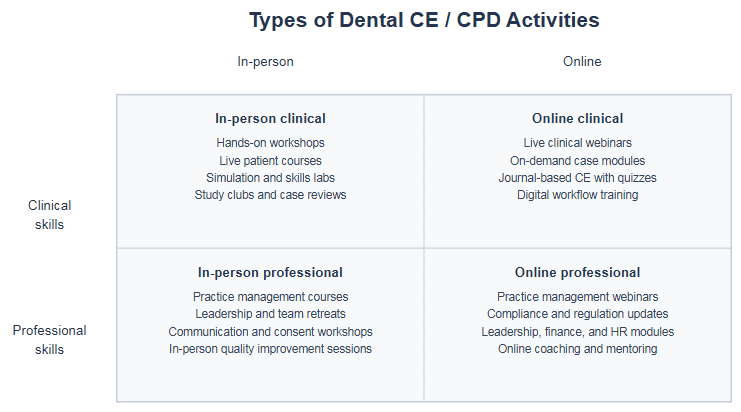
6. Types of Dental CE/CPD Activities
Most regulators allow a mix of different learning formats. To get the best value from your time and budget, it helps to understand the main options.
6.1 Live, in person learning
Traditional in person activities include:
- National and regional dental conferences.
- One or two day courses on specific clinical topics.
- Hands on workshops and simulation sessions.
- Local study clubs, peer review meetings, and journal clubs.
In person learning offers networking opportunities, informal discussion, and practical skills training that can be difficult to replicate online.
6.2 Online and on demand learning
Online CE/CPD has grown rapidly and now includes:
- Live webinars and virtual conferences with question and answer sessions.
- On demand lecture series with quizzes or assignments.
- Self paced modules from universities, hospitals, and professional providers.
Online learning offers flexibility and access to content from outside your local area. Many regulators accept some or all online hours, but a few limit the proportion that can be completed through self study, so it is important to check your local rules.
6.3 Blended and longitudinal programs
For more advanced skills, blended models are increasingly common. These may combine:
- Pre course online theory and reading.
- A concentrated in person hands on component.
- Post course mentoring, case presentations, or follow up webinars.
This approach is common in implantology, periodontology, orthodontics, and complex restorative disciplines, and can be highly effective for changing practice when well designed.[1,10]
6.4 Self directed and scholarly activities
Many frameworks also recognize activities such as:
- Journal based CPD with quizzes or structured reflections.
- Preparing and delivering lectures or workshops.
- Publishing peer reviewed articles or research.
- Participating in audit, quality improvement, or guideline development.
These activities can be powerful learning experiences but may be subject to caps or special rules, so they should be planned in line with your regulator’s guidance.
7. How To Judge the Quality of CE/CPD
Collecting hours is straightforward. Collecting high value hours that genuinely improve care takes more thought. When you choose courses, consider the following.
7.1 Accreditation and recognition
In North America, many regulators prefer or require CE from providers that are:
- Recognized by the American Dental Association’s Continuing Education Recognition Program (ADA CERP).
- Approved by the Academy of General Dentistry’s Program Approval for Continuing Education (AGD PACE).
- Directly approved or endorsed by provincial or state regulators.[4,6]
In the UK and Europe, look for courses that:
- Map to GDC development outcomes in the UK.
- Are delivered by universities, hospitals, or established professional bodies.
- Align with national CPD frameworks or core topic lists derived from projects such as DentCPD.[7,8,10,12]
7.2 Educational design
Evidence from CPD research suggests that effective programs tend to be:
- Interactive rather than purely didactic.
- Focused on real clinical problems and case discussions.
- Multi component, combining information with practice and feedback.
- Designed with clear, measurable learning objectives.[1-3]
7.3 Faculty and bias
Before you invest in a course, ask:
- Who is teaching, and what is their track record in the topic?
- Is there a clear disclosure of commercial relationships and sponsorship?
- Is the content balanced, or is it essentially a product demonstration?
7.4 Assessment and reflection
High quality CE/CPD normally includes some form of assessment or reflection, such as:
- Pre or post tests to check understanding.
- Case based discussions with feedback.
- Structured reflection forms or action plans.
These elements not only improve learning but may also be required for CPD to count as “verifiable” in systems such as the GDC’s enhanced CPD scheme.[5,12]
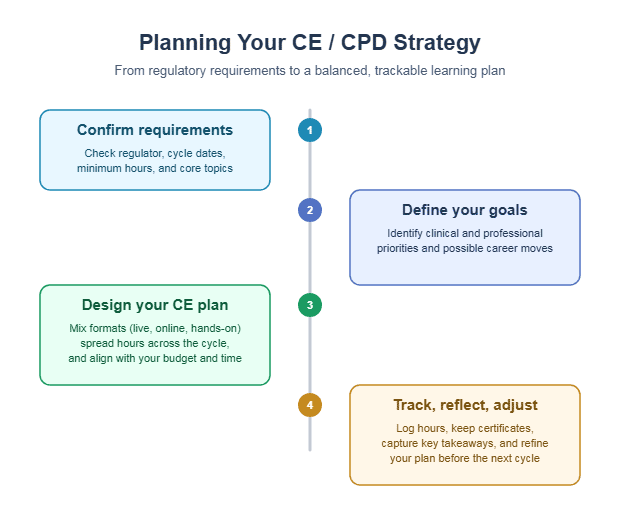
8. Planning Your CE/CPD Strategy
Rather than collecting random hours near the end of a cycle, it is more effective to plan your CE/CPD in the same way you would plan other business or career investments.
8.1 Start with your regulator
Begin by confirming:
- Your renewal or CPD cycle dates.
- The total number of hours or points required per cycle.
- Any minimums or caps by category (for example, clinical vs non clinical, in person vs online).
- Any mandatory topics (for example, medical emergencies, radiography, infection control, safeguarding, ethics, opioids, health equity).
- Documentation and audit rules.[4-6,11,12]
8.2 Align CE/CPD with your goals
Next, identify your priorities. Ask questions such as:
- What clinical areas do I want to strengthen in the next one to two years?
- What new services do I want to add to the practice?
- Do I plan to move into ownership, leadership, teaching, or research?
- Am I likely to move to another region or country, and if so, what CPD will be most portable?
Use your answers to select courses that both satisfy regulatory requirements and move you toward your ideal practice mix.
8.3 Build a balanced plan
A balanced three to five year plan might include:
- One major conference or multi day event per year for broad updates and networking.
- Two to four focused clinical courses each year for depth in specific topics.
- Ongoing online modules and journal based CPD to maintain core topics.
- Occasional workshops on communication, leadership, or business skills.
Spreading CE/CPD across the cycle reduces stress and improves retention compared with leaving everything to the final months.
8.4 Planning across borders
If you might move country or region in the future:
- Prioritize courses from universities, hospitals, and well known professional bodies.
- Keep detailed certificates that list the provider, accreditation, learning outcomes, and hours.
- Save course syllabi and program descriptions in case a new regulator asks for more detail.[7-10]
9. Documentation, Audits, and Staying Compliant
9.1 How to track your CE/CPD
An organized tracking system makes compliance and audits much easier. At a minimum, record:
- Course title and topic.
- Date, location, or platform.
- Provider name and any accreditation (for example, ADA CERP, AGD PACE, GDC aligned).
- Number of hours or points awarded.
- Category (clinical/non clinical, verifiable/non verifiable, in person/online).
Many regulators encourage or provide electronic portfolios. For example, the RCDSO’s e Portfolio allows Ontario dentists to record CE points and store verification documents online as part of the Quality Assurance Program.[4,6,11]
9.2 Audits
Random or targeted audits are increasingly common. They may involve:
- Requests for copies of certificates and attendance records.
- Review of your CPD plan and reflective notes.
- Checks that mandatory topics and core hours have been met.
Canadian, UK, European, and other CPD frameworks all include some form of portfolio review or CPD evidence check, and regulators may impose remedial requirements if gaps are identified.[4,5,7-9,11]
9.3 Common pitfalls
Common problems that emerge during audits include:
- Falling short of total hours or points.
- Missing mandatory topics, such as medical emergencies or radiography safety.[5,8]
- Relying on non approved providers when rules require recognized accreditation.
- Misclassifying non clinical content as clinical hours.
- Leaving CE/CPD to the last minute and struggling to find appropriate courses.
10. Where To Find High Quality Dental CE/CPD (and How CE Crowd Can Help)
There is no single global directory for dental CE/CPD, but you can usually find suitable options through:
- National and regional dental associations.
- Specialty organizations in areas such as orthodontics, periodontics, implantology, pediatric dentistry, and prosthodontics.
- Dental schools and university continuing education departments.
- Hospitals and health system education centers.
- Reputable online CE/CPD platforms and course providers.
CEcrowd.com is designed to make this landscape easier to navigate. Instead of visiting multiple websites, you can:
- Browse dental CE/CPD courses from many organizers in one place.
- Filter by country or state/province, topic, date, format (live, webinar, on demand), and profession (dentist, hygienist, therapist, and more).
- Compare course details such as hours, location, and organizer at a glance.
As CE Crowd grows, it can also support strategic planning by linking to tools such as CE planning checklists or CE ROI calculators, so you can prioritize courses that deliver both educational value and practice impact.
11. Key Takeaways
- Dental CE/CPD is now a core expectation for dentists and dental hygienists in most regions of the world.[4,5,7-10]
- Requirements vary by regulator but usually involve a multi year cycle with minimum hours or points and some mandatory core topics.
- Well designed CPD has the potential to improve clinical performance and can contribute to better patient outcomes in some areas of care.[1-3]
- Planning your CE/CPD around your career goals and patient needs makes it far more valuable than simply meeting minimum numbers.
- Accurate documentation and organized records are essential in case you are audited.
- Tools like CE Crowd can help you discover, compare, and plan CE/CPD activities that fit your region, role, and long term objectives.
This article provides a broad global overview. Before making any decisions about license renewal, registration, or compliance, always confirm the latest CE/CPD requirements with your own dental board, college, council, or regulatory authority.
References
- Firmstone, V. R., Bullock, A. D., & Walls, A. W. G. (2013). Systematic review of the effectiveness of continuing dental professional development on learning, behaviour or patient outcomes. European Journal of Dental Education, 17(2), e70–e79.
- Samuel, A., Cervero, R. M., Durning, S. J., & Maggio, L. A. (2021). Effect of continuing professional development on health professionals’ performance and patient outcomes: A scoping review of knowledge syntheses. Academic Medicine, 96(6), 913–923.
- Ali, S., Sethi, A., Soltani, A., & Nazar, Z. (2025). Impact of continuing professional development (CPD) on patient outcomes: A systematic scoping review. BMC Medical Education, 25, 1284.
- Royal College of Dental Surgeons of Ontario. (n.d.). Quality Assurance Program. Toronto, Canada: RCDSO.
- General Dental Council. (2024). Enhanced CPD guidance for dental professionals. London, UK: General Dental Council.
- Royal College of Dental Surgeons of Ontario. (n.d.). Continuing education. Toronto, Canada: RCDSO.
- Barnes, E., Bullock, A. D., Bailey, S. E. R., Cowpe, J. G., & Karaharju-Suvanto, T. (2013). A review of continuing professional development for dentists in Europe. European Journal of Dental Education, 17(Suppl 1), 5–17.
- Bailey, S., Bullock, A., Cowpe, J., Karaharju-Suvanto, T., & Barnes, E. (2013). Core continuing professional development (CPD) topics for the European dentist. European Journal of Dental Education, 17(Suppl 1), 23–28.
- Fesenko, I. I., Marchenko, N., & Irkha, S. (2024). Continuing professional development (CPD) for Ukrainian stomatologists (dentists) and maxillofacial surgeons: Criteria for awarding CPD points as of 2024. Journal of Diagnostics and Treatment of Oral and Maxillofacial Pathology, 8(5), 53–64.
- Meli Attard, A., Bartolo, A., & Millar, B. J. (2022). Dental continuing professional development – Part I: Background on dental continuing professional development in Europe. European Journal of Dental Education, 26(3), 539–545.
- Sowingo. (2020, April 14). Where to find online continuing education? Sowingo Blog.
- College of General Dentistry. (n.d.). GDC development outcomes. London, UK: College of General Dentistry.

I’m a pre-dent student and this was really helpful. I’d heard about CE/CPD but didn’t realize how it actually works in different countries—this makes the whole “lifelong learning” thing way clearer.
Thanks so much for reading, Jordan! Really glad it helped make CE/CPD feel a bit clearer and less intimidating. Lifelong learning is a big part of dentistry, but it can also be a great way to shape your career in the direction you want. Wishing you all the best on your path to dental school!